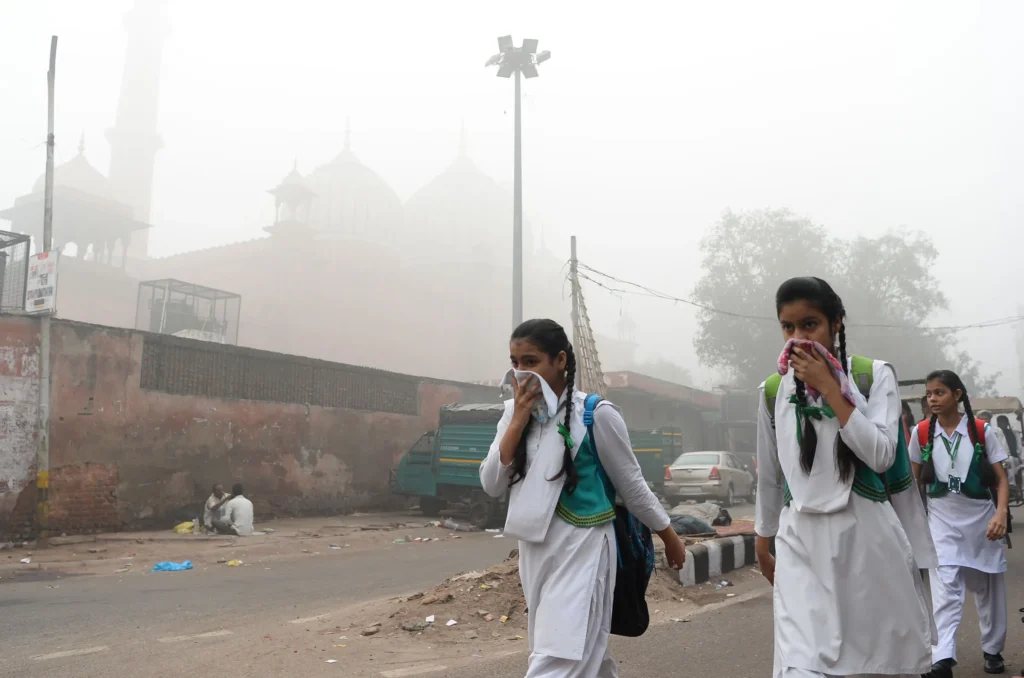
Delhi has spent years trying to breathe through a haze dense enough to qualify as its own season, but the latest numbers make the crisis feel less abstract and more like a slow-moving public health disaster. Between 2022 and 2024, six government hospitals logged more than 200,000 cases of acute respiratory illness, a volume so enormous it almost reads like a typo, until you remember the city’s air sometimes clocks in at twenty times the pollution levels the WHO considers safe.
More than 30,000 people had to be admitted just to keep themselves breathing. The rest did what Delhi residents do every winter: endure it, because endurance has somehow become part of urban life in the capital.
There isn’t a single villain to point at, which makes the crisis even easier for everyone to ignore. Industrial smoke, endless traffic, cold stagnant air, the seasonal burning of crop stubble, the meteorological shrug of low wind speeds together they trap the city under a grey lid that tightens as temperatures drop. It’s a mechanical problem with a political shadow, and every year the pattern repeats like clockwork.
The government told parliament that emergency rooms fill up as pollution spikes, though it quickly added that this “does not prove causality.” A strangely academic disclaimer considering Delhi’s AQI routinely leaps past the “severe” 400 mark, a level at which even healthy lungs take damage and those with existing conditions face genuine danger. As if the city needs a research paper to confirm what everyone’s lungs already know.
On Wednesday morning, the AQI hovered near 380, a number that would be a national emergency in many countries, but in Delhi passes as just another weekday. Pediatric wards have been reporting waves of children with inflamed lungs and relentless coughs, an annual ritual that shouldn’t exist but somehow does.
Courts have stepped in before, scolding governments and agencies for failing to curb the smog, and another urgent petition is now on the docket. But winter arrives faster than solutions, and each year Delhi braces itself for a fight it keeps losing, one breath at a time.
It’s a modern paradox: a city of more than 30 million people, full of ambition, energy, noise, and movement, yet the basic act of breathing has become its most dangerous daily activity.