At some point, reports began circulating that Venezuela’s president had been kidnapped.
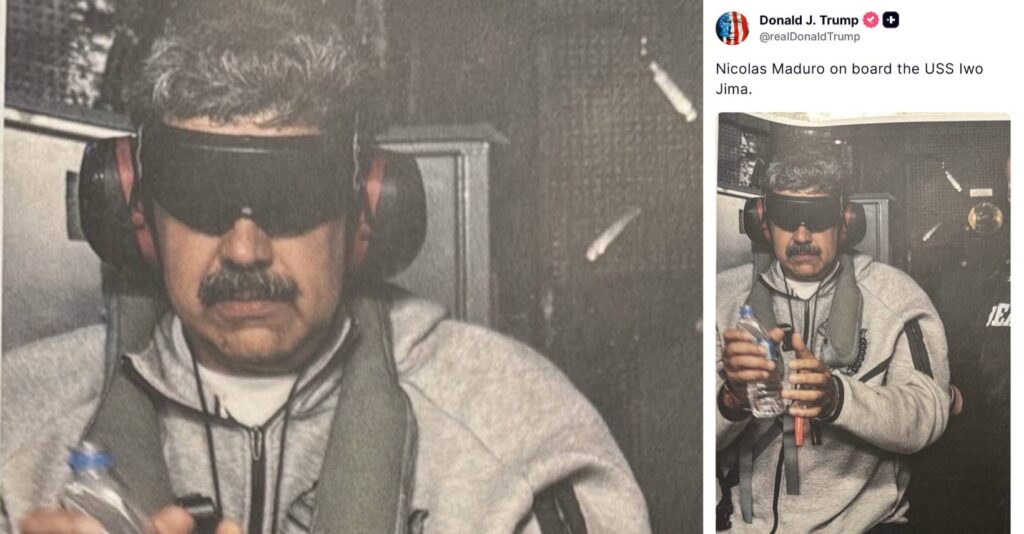
There was no clear sequence of events. No universally accepted timeline. No single authority capable of stating, with confidence, what had actually happened. But the word itself – kidnapped – was already everywhere. In headlines. In statements. In reactions that came faster than verification.
And once that word appeared, the shape of the story was set.
In modern politics, control over the narrative matters more than control over the person. A president can vanish physically for hours or days, but the story of that disappearance begins operating immediately – shaping reactions, legitimizing moves, narrowing interpretations.
Truth, if it arrives at all, usually comes last.
The power of naming before knowing
“Kidnapping” is not a neutral descriptor. It is a political instrument.
It implies illegitimacy. It assigns moral positions instantly. There is a victim, an aggressor, and an emergency that demands response. It leaves little room for ambiguity, and even less for patience.
Once the term is deployed, alternatives become suspect. Questioning the framing sounds like denial. Asking for confirmation sounds like stalling. Silence sounds like complicity.
This is why politically charged events are named before they are understood.
Language moves faster than facts and in moments of instability, speed is power.
In Venezuela’s case, the situation unfolded in an environment already saturated with distrust, polarization, and international pressure. The country exists in a permanent state of narrative tension, where legitimacy is constantly contested and every action is interpreted through competing lenses.
In such an environment, what something is called matters more than what it is.
Competing realities are not a glitch, they are the system
Almost immediately, multiple versions of events began circulating.
One narrative framed the incident as an illegal seizure of power. Another described it as a lawful intervention. A third suggested internal maneuvering disguised as chaos. A fourth hinted at foreign involvement without providing evidence.
These versions did not replace one another. They coexisted.
This coexistence is often described as confusion, misinformation, or failure of communication. That description is comforting and wrong.
In contemporary political conflicts, parallel narratives are a strategy, not a breakdown.
When no single version fully dominates, accountability dissolves. Responsibility becomes negotiable. Every actor gains room to maneuver while claiming uncertainty. Action can be taken without fully committing to a justification.
Confusion buys time.
Time buys leverage.
Why clarity is dangerous for power
Observers often ask why facts do not immediately settle such situations. Why investigations do not quickly clarify what happened. Why international responses remain cautious or contradictory.
The uncomfortable answer is that clarity constrains power.
Once a narrative hardens into fact, options narrow. Allies must choose sides. Opponents must respond. Legal frameworks activate. Consequences follow.
Ambiguity, by contrast, preserves flexibility.
It allows statements to be revised. Positions to shift. Decisions to be framed as provisional. Actions to be taken “pending confirmation” and then quietly normalized once confirmation never fully arrives.
This is why official language is so carefully calibrated in moments like this. Confirmations are partial. Denials avoid specifics. Accusations of “disinformation” replace explanations.
The goal is not to convince.
It is to delay convergence.
Disappearance as a political resource
Whether the president was physically detained, temporarily removed, protected, relocated, or maneuvered out of sight matters less in the immediate phase than how the disappearance functions politically.
A disappearance creates a vacuum.
Vacuum invites intervention.
In that space, extraordinary measures become easier to justify. Emergency language activates. Legal norms stretch. Actions that would normally face resistance slide through under the cover of uncertainty.
This is not new. What has changed is the speed.
In earlier eras, such moments unfolded over days or weeks. Today, the narrative phase compresses into hours. Social media, real-time news, and diplomatic signaling collapse the window between event and interpretation.
By the time facts emerge, the critical decisions have already been made.
The international theater of hesitation
International reactions to such events often appear cautious, fragmented, even incoherent.
This is not necessarily weakness. It is calculation.
Foreign governments understand that early alignment carries risk. Endorsing one narrative too quickly can lock a country into positions that become untenable once details change. Remaining ambiguous preserves diplomatic mobility.
At the same time, expressions of “concern,” “monitoring,” and “calls for clarification” perform an important function: they acknowledge the event without endorsing a version of it.
This is politics conducted in the conditional tense.
The result is a strange global choreography where everyone appears to be waiting, not for truth, but for narrative stabilization.
When the story becomes more real than the event
In situations like this, something subtle but decisive happens: the story overtakes the event.
Media coverage focuses less on what occurred and more on reactions to what is believed to have occurred. Statements respond to statements. Condemnations reference reports. Analysis builds on speculation.
Reality becomes layered, then buried.
At that point, even definitive evidence struggles to reset the narrative. Corrections lack the emotional force of first impressions. Clarifications do not spread as widely as accusations. Retractions do not undo positioning.
By the time truth arrives, if it arrives, it feels anticlimactic – almost irrelevant.
The damage, or advantage, has already been secured.
Why Venezuela is not the exception
It would be easy to frame this as another episode in Venezuela’s long political crisis. Another example of instability, institutional weakness, or authoritarian maneuvering.
That framing is convenient and misleading.
What this episode illustrates is a broader transformation in how political power operates globally. Leaders no longer need to fully control institutions if they can control interpretation. They no longer need to suppress information if they can flood the space with competing versions.
In this model, truth does not need to be eliminated. It only needs to be delayed long enough to lose strategic relevance.
Venezuela is not unique in this regard. It is simply more visible.
The role of the audience in twisted politics
There is a final, uncomfortable dimension to this story: the role of the observer.
Audiences are trained to consume political crises as narratives. Heroes, villains, coups, rescues, betrayals. The complexity of reality is flattened into digestible arcs.
This creates pressure for speed over accuracy. For clarity over honesty. For emotionally satisfying explanations over uncertain ones.
In that environment, ambiguity feels intolerable. So it gets filled.
Twisted politics thrives not just on manipulation, but on demand.
When politics stops explaining and starts obscuring
A president’s disappearance should be a moment of maximum transparency. Instead, it becomes a fog.
Not because the truth is unknowable, but because uncertainty serves too many interests to be resolved quickly.
This is what twisted politics looks like in practice: a reality where events matter less than the narratives attached to them, where language does the work before facts arrive, and where power operates in the space between versions.
By the time the story settles, if it ever does, the consequences are already in motion.
And the most important decisions have been made not in the light of truth, but in the shadow of uncertainty.
This is not a text about Venezuela alone.
It is a text about how political reality is manufactured under pressure.
And once you start seeing it this way, you stop asking “what really happened?” as your first question.
You start asking something far more dangerous:
“Who benefits from not letting us know?”